Government
Georgia's new check-in rule writes your name on a sign-in sheet — not your ballot
Why you don't have to worry about poll workers marking your ballot
By Staff · October 13, 2026
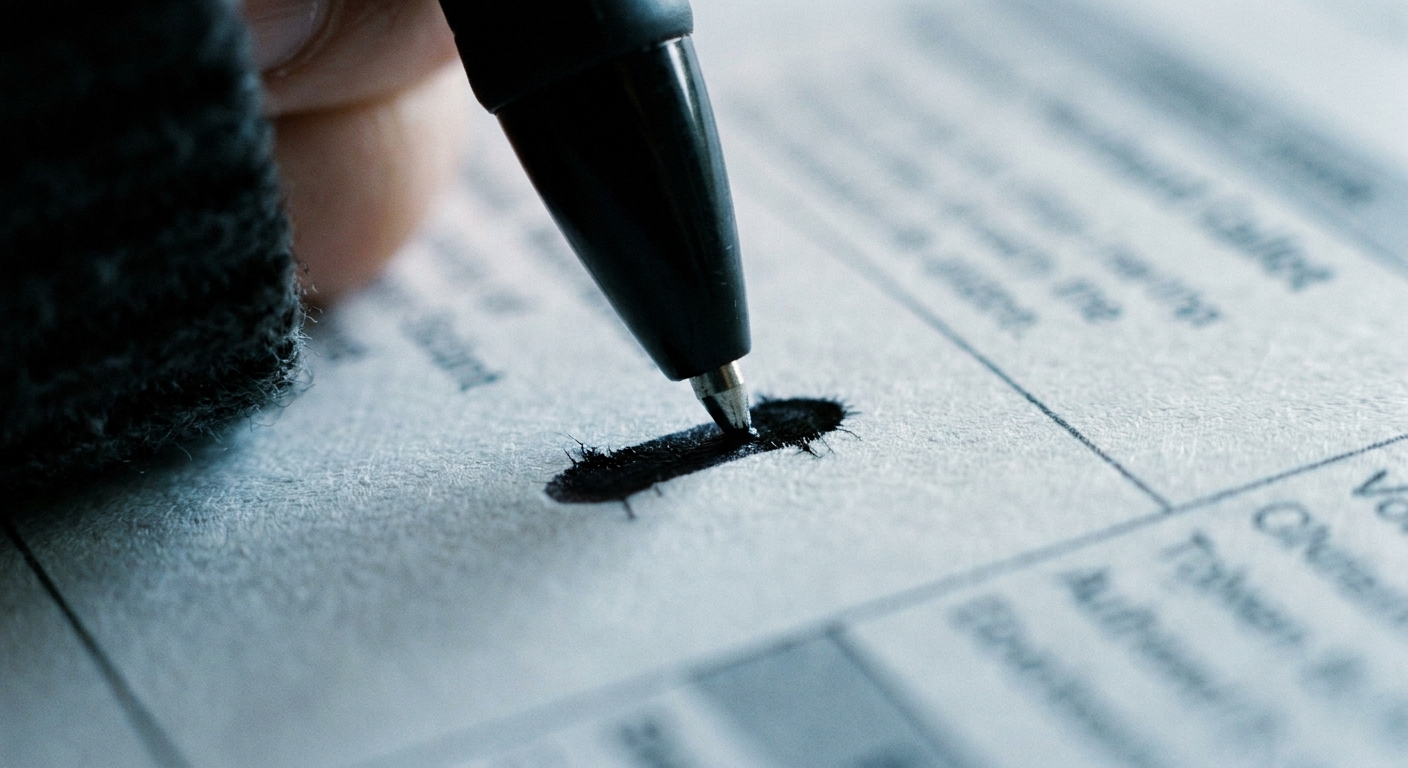
A message circulating among Georgia voters makes a blunt claim: "Your ballot will be disqualified if it is written on." The message tells voters that if a poll worker adds "a letter, a checkmark … an R or a D," they should demand a replacement ballot.
The message lands in the final weeks before the November 3, 2026 general election — as Gwinnett County enters its advance in-person voting period. It plants a specific fear: that a single stray mark by a poll worker could cost you your already-cast vote.
That fear has the mechanics backwards.
A Georgia State Election Board rule that took effect July 19, 2026 requires poll workers to write each voter's name "in ink" on "the appropriate numbered list of voters" during check-in, after they confirm the person's identity and registration in the precinct. The rule states it plainly: "The voter's name shall then be recorded in ink and entered on the appropriate numbered list of voters."
It defines that "numbered list of voters" as "one or more sheets of uniform size containing consecutively numbered blank spaces for the insertion of voters' names" in the order they receive ballots. In other words, a paper sign-in sheet — not a ballot.
Hall County Elections' October 6 notice spells out the change: poll workers write each name in ink on the separate numbered list after verifying identity and registration. Electronic check-in stays in place, the extra step takes only a few seconds, and voters need not do anything additional.
"This is an additional step for our poll workers, not for the voter," said Lori Wurtz, Hall County's elections director.
It sits alongside electronic check-in, not in place of it.
What the poll worker actually writes
At the check-in table, the only thing a poll worker writes is your name, in ink, on the numbered sign-in list. That handwriting happens there, on that paper.
Only after that does a voter receive a ballot and mark their own selections. The ballot is a separate piece of paper, and nothing a poll worker writes on the sign-in sheet ever carries over onto it.
So a poll worker's check-in scribble cannot disqualify your ballot, because it never touches the ballot to begin with. The rule requires poll workers to record a voter's name — not a letter, a checkmark, or a party label such as "R" or "D." The only marks on your ballot are the ones you make yourself.
If a ballot ever does need replacing
The rule's one replacement process concerns the voter's own ballot, not a worker's handwriting. According to the State Election Board rule, if a voter finds their printed ballot does not contain the proper selections, they must tell a poll officer right then; the officer spoils that paper ballot, and the voter marks a fresh one. The rule states that once a paper ballot goes into the scanner or box, the person is deemed to have voted and cannot cast another.
For Gwinnett voters, the practical part is to confirm the schedule before going. The county's advance-voting page lists the in-person period for the November 3 general election as Tuesday, October 13 through Friday, October 30, every day including Saturdays and Sundays, from 7 a.m. to 7 p.m. A separate official county news release says advance voting began Monday, October 12; voters should confirm their preferred location and hours before going.
Registered Gwinnett voters can cast an advance ballot at any of the county's 13 advance-voting locations, including the Gwinnett Voter Registrations and Elections Beauty P. Baldwin Building at 455 Grayson Highway, Suite 200, and Rhodes Jordan Park, both in Lawrenceville. On Election Day, November 3, voters must use their assigned precinct; state law provides for voting hours from 7 a.m. to 7 p.m., and voters should confirm their precinct's hours with Gwinnett County before going.
If you are ever unsure about a mark you see — on the sign-in list or anywhere near your ballot — ask the poll worker or the poll manager right then, in the room, instead of acting on something you read in a text. If your actual ballot is damaged or you mark it wrong yourself, tell a poll officer immediately so it can be spoiled and you can mark a fresh one. That is the only replacement avenue, and it has nothing to do with a worker's handwriting.
Where the rumor likely comes from
The most likely source of the confusion is the newly required handwriting at check-in — a step many voters had not seen before July 2026 — being misread as someone writing on a ballot.
What voters in Gwinnett will see this fall is the same check-in, plus a name written in ink on a separate sheet. The one piece of paper at the polling place no one else writes on is your ballot — and it stays untouched until you mark it yourself.